What a Slicker Brush Is Built to Do
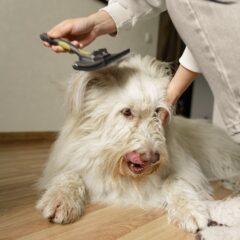
A slicker brush has a flat or slightly curved head packed with fine, short, angled wire pins. Those pins work at the surface and the middle of the coat, teasing apart small tangles, lifting loose hair and smoothing the topcoat to a tidy finish.
It is the more versatile of the two tools and suits the widest range of coats: curly and wool coats, medium and long coats, and the topcoat of double-coated breeds. What a slicker does not do well is reach the dense, woolly undercoat deep against the skin of a heavy double coat; the pins are simply too short to penetrate that far. For choosing between models, see the best brush for your coat type.
Slicker pins are fine and firm. Let their weight do the work; pressing hard scratches the skin and causes brush burn.
What an Undercoat Rake Is Built to Do
An undercoat rake looks quite different: usually a single row (sometimes two) of long, rounded metal teeth set into a T-shaped handle. Those long teeth are designed to pass through the topcoat and reach the soft, dense undercoat beneath, pulling out the dead woolly hair that a slicker cannot touch.
The rake is the specialist deshedding tool for double-coated breeds such as German Shepherds, Huskies, Malamutes, Collies and Golden Retrievers, especially during the twice-yearly moult. It has little purpose on a single-coated curly or silky dog, which has no undercoat to rake. Used well, it is central to deshedding a double coat without damage.
Rake gently in the direction the coat grows, in short strokes. Digging in or scraping against the grain hurts and can scratch the skin.
Which Tool for Which Coat
The decision comes down to whether your dog has an undercoat and what you are trying to achieve.
- Curly / wool (Poodle, Doodle, Bichon): slicker plus comb. No rake needed.
- Long / silky (Yorkie, Shih Tzu): slicker and pin brush plus comb. No rake needed.
- Double coat (Husky, Shepherd, Collie): both. Rake to clear the undercoat, slicker to finish the topcoat.
- Short / smooth (Labrador, Beagle): neither, really. A rubber curry suits best.
In short, a slicker manages tangles and finish across most coats, while a rake solves the specific problem of a shedding undercoat.
A slicker cannot clear a dense undercoat and a rake cannot smooth a topcoat. On a double coat you genuinely need the pair.
Using Both Tools in the Right Order
On a double coat the two tools are a team, and the order matters. Start with the undercoat rake to pull out the bulk of the loose, dead underlayer while the coat is dry and freshly brushed of debris. Work in sections, following the grain, until the rake comes through with noticeably less hair.
Then switch to the slicker brush to lift any undercoat the rake loosened but left behind and to smooth the topcoat into a neat lie. Finish, as always, by running a steel comb through to confirm you have reached the skin everywhere. A self-cleaning slicker like the Hertzko slicker speeds up the finishing pass on a heavy shedder.
Clearing the undercoat before you smooth the top means the slicker glides and you are not fighting trapped hair.
If you buy through our links we may earn a commission at no extra cost to you.
Frequently Asked
Only if your dog has a double coat. Double-coated breeds need the rake to clear the undercoat and the slicker to finish the top. Single-coated curly, silky or short-haired dogs need only a slicker or curry brush, never a rake.
No. Poodles and most Doodles are single-coated wool types with no undercoat to rake, so the tool does nothing useful and can scratch the skin. They need a firm slicker and a comb used with the line-brushing method instead.
No. A rake has long, rounded teeth that pull loose undercoat out gently. Blade-style deshedding tools cut hair with an edge and, used too hard, can damage the topcoat and thin the coat. For routine care, a rake is the safer choice.
On a double coat, rake first to remove the bulk of the dead undercoat, then use the slicker to lift the remainder and smooth the top layer. Finishing with a comb confirms nothing is left knotted near the skin.