The Core Brushes and What Each One Does
Every brush is designed for a job, and using the wrong one is why so many coats stay knotty despite regular effort. Learn the five workhorses first.
- Slicker brush: fine, angled wire pins on a flat head; lifts loose hair and teases apart small tangles. The all-rounder for most coats.
- Undercoat rake: a single row of long, rounded teeth that reaches deep to pull dead undercoat from double coats.
- Pin brush: widely spaced pins with rounded tips; gentle finishing on long, silky coats.
- Bristle brush: soft natural or nylon bristles that lift surface dirt and spread oils on short coats.
- Rubber curry: flexible nubs that massage and grab shedding hair from smooth coats.
Owning the right one or two of these for your dog matters far more than owning all five. Once you know your dog’s coat type, the choice narrows quickly.
Whatever else you own, a stainless steel comb is essential as your checking tool. It tells you honestly whether the brush has done its job.
Best Brushes for Short and Double Coats
For a short, smooth coat (Labrador, Boxer, Staffie), a rubber curry brush or a bristle brush is ideal. It lifts the constant fine shed, spreads natural oils for shine, and doubles as a pleasant massage. There is rarely any need for a slicker on these dogs.
A double coat (German Shepherd, Husky, Collie, Golden Retriever) has a coarse topcoat over a dense woolly undercoat, and it needs two tools: a slicker for the topcoat and an undercoat rake to clear the dead underlayer. The difference between these two is worth understanding, which we cover in our slicker versus rake comparison.
The undercoat insulates against heat as well as cold. Rake it out to thin it; clipping it off can damage regrowth permanently.
Best Brushes for Curly, Wool and Silky Coats
Curly and wool coats (Poodle, Bichon, Cockapoo, Labradoodle) mat readily and need a firm slicker brush plus a comb, used daily with the line-brushing method. The slicker opens the curl while the comb confirms you have reached the skin. This is the foundation of caring for a doodle coat.
Long, silky coats (Yorkshire Terrier, Shih Tzu, Afghan) are prone to friction knots but the hair is finer and more fragile, so a pin brush for daily maintenance and a slicker for problem areas strikes the right balance. Always follow with a fine-to-medium comb to catch anything the pins glide over.
On fine silky hair, hold the slicker loosely and let the pin weight do the work. Digging in snaps the delicate strands.
What to Look For in a Brush That Lasts
A well-made brush is a genuine pleasure to use and gentler on the dog, so it pays to choose carefully rather than replacing a poor one repeatedly. Look for firmly anchored pins that do not splay, a comfortable non-slip handle, and, on slickers, wires with a slight give rather than rigid spikes.
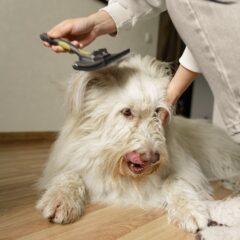
Self-cleaning slickers, where a button retracts the pins to release trapped hair, save real time on a heavy shedder. A dependable example is the Hertzko self-cleaning slicker. Whatever you buy, check the pin tips are rounded or coated; sharp, uncapped ends scratch the skin and put dogs off grooming for good.
Press a slicker gently against your own forearm. If it scratches you, it will scratch your dog. Choose one that feels firm but never sharp.
If you buy through our links we may earn a commission at no extra cost to you.
Frequently Asked
A slicker brush is the closest thing to an all-rounder, as it suits most double, curly and medium coats. Pair it with a stainless steel comb and you can maintain the majority of breeds. Only very short, smooth coats are better served by a rubber curry.
Most coats need at least two tools: a brush to work the coat and a comb to check it. Double and long coats genuinely need two brushes plus a comb, because no single head both clears the undercoat and finishes the top layer well.
For heavy shedders and dense coats, yes. Retracting the pins to shed a wad of trapped hair with one button press keeps you brushing rather than picking. For a light-coated dog groomed briefly, a standard slicker is perfectly adequate.
Avoid poorly made slickers with sharp, uncoated pins, and steer clear of blade-style de-shedding tools used aggressively, as they can cut the topcoat and thin the coat over time. Any tool that removes hair with force rather than lifting it deserves caution.