Understand Why Coats Mat in the First Place
A mat is shed hair that has not been able to fall away. Instead it stays trapped in the coat, wraps around living hairs and, with movement and moisture, tightens into felt. Understanding this makes prevention obvious: your job is simply to remove loose hair before it can knot.
Curly, wool and long coats mat fastest because the hair holds onto everything it sheds. Moisture accelerates it dramatically, which is why a wet, muddy walk or a swim so often ends in knots. Friction is the third factor, and it explains why mats always appear first in the same predictable places.
Most coats are professionally groomed every six to eight weeks. Everything that happens to the coat in between is down to you.
Target the Friction Zones Where Mats Start
Mats rarely begin in the open expanses of the back. They start where hair rubs against itself or against kit, so a targeted daily check of these zones prevents the vast majority of problems.
- Behind and under the ears, and the ear leather itself
- The armpits and the chest where the legs meet the body
- Under a collar or harness, and along the collar line
- The britches (back of the thighs) and around the tail base
- Between the toes and the back of the pasterns
If you only manage a short session, spend it here. A harness left on all day is a common hidden cause; consider removing it indoors and brushing the area it covers.
Always brush the exact strip of coat that sits beneath a collar or harness. Constant rubbing there felts hair faster than anywhere else.
Line Brush to Reach Every Layer
Surface brushing leaves a felted layer forming unseen against the skin. Line brushing is the technique that prevents this and is the single most valuable habit for a mat-prone coat.
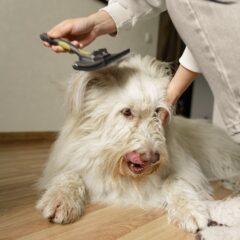
Part the coat in a horizontal line, use your free hand to hold the hair above the parting out of the way, then brush the exposed strip downward from the skin outwards. Move the parting up a centimetre and repeat, working in sections up the body. Follow every brushed area with a comb: if the comb glides cleanly to the skin, that section is done. This is the same method that keeps a doodle coat manageable between salon visits.
A coat can look immaculate on top while a solid mat sits underneath. Line brushing is the only reliable way to reach the base.
Daily Habits and Damp-Coat Discipline
Consistency beats intensity. A few honest minutes every day keeps a coat open far more reliably than a long weekly session, because you never let loose hair accumulate long enough to knot. Build the check into a fixed part of the day so it simply happens.
Be especially disciplined around moisture. After rain, mud or swimming, dry the coat fully and brush it out before it dries into knots; brushing a damp curly coat without care tightens tangles rather than removing them. If you find a small mat, tease it apart with your fingers and a little detangling spray, or split it with the tip of blunt-nosed scissors held parallel to the skin, rather than yanking it with a brush. Larger or tight mats are safer handled as set out in removing mats and tangles.
Damp hair mats more easily. Get the coat properly dry after any soaking, then brush, and knots become far less likely.
If you buy through our links we may earn a commission at no extra cost to you.
Frequently Asked
Curly, wool and long coats need brushing every day to stay mat-free between grooms. Double coats can manage two or three sessions a week, more during a seasonal shed. Short coats rarely mat and need only a weekly tidy.
Yes. Constant rubbing where a harness or collar sits felts the hair beneath it quickly, and this is one of the most common hidden causes. Remove the harness indoors where safe, and always brush the coat underneath it as part of your routine.
A leave-in detangling spray reduces friction and helps a brush glide, so it makes daily maintenance easier and knots slower to form. It is a useful aid, not a substitute for brushing. Nothing replaces physically removing the loose hair.
Curly and wool coats hold every shed hair, so felting begins within days if brushing lapses. Regrowth after a close groom passes through a fluffy, tangle-prone stage too. Daily line brushing through that phase is what keeps the coat open.